



Zibo Great Sailing Light Industrial Products Co., Ltd. is one of the leading manufacturers and suppliers of 3 gallon glass drink dispenser with lid and spigot in China. With abundant experience, we warmly welcome you to buy bulk customized 3 gallon glass drink dispenser with lid and spigot from our factory. If you have any enquiry about cooperation, please feel free to email us.
3 Gallon Glass Drink Dispenser with Lid and Spigot
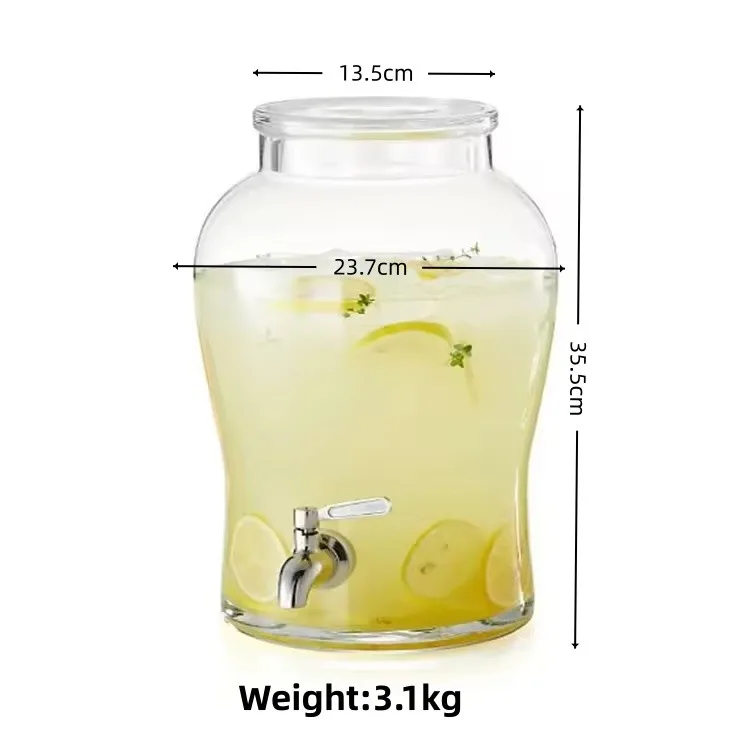
A 3 gallon glass drink dispenser for hotel breakfast service, catering, party rental and retail gifting programs, built on a mold we already run, so a private label order starts at 1,000 pieces with no tooling charge.
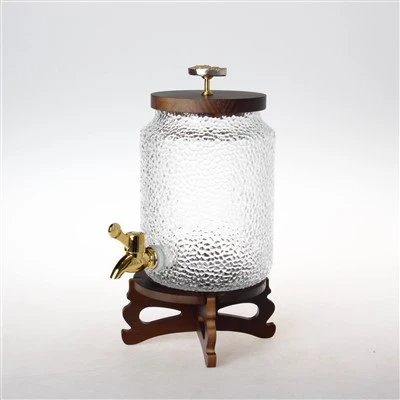
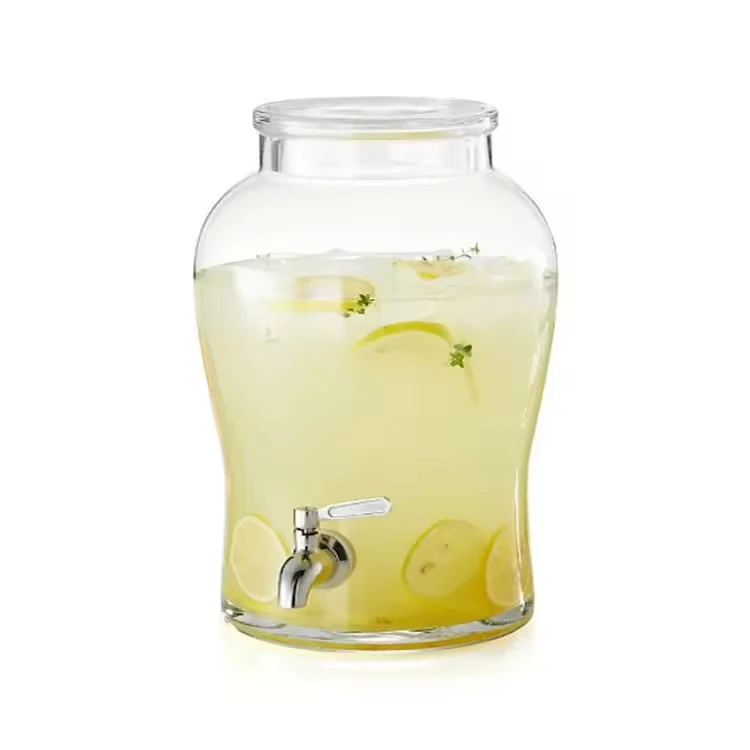
The body is machine-made soda-lime glass: 35.5 cm tall, 23.7 cm across the widest point, 13.5 cm at the mouth, 3.1 kg empty. The spigot is a stainless steel assembly with a silicone gasket, fitted at the lowest point of the body so the last liter still pours. Lid and base are separate components: a pressed glass lid as standard, an acacia wood lid on request, and a base in acacia, marble, iron wire or hammered metal.
A tap at the bottom is a tap that empties the jar
The spigot is fitted through a bore at the lowest point of the body, so an 11 L jar pours down to the last serving without being tipped forward. A tap set a few centimeters up the wall leaves that much drink behind on every refill, and on a buffet that is the difference between one pour and two.
It is a threaded stainless steel assembly seated on a silicone gasket, and it replaces from the outside. On a rental fleet or a hotel floor, a damaged tap is a component swap rather than a written-off jar. The glass body itself carries no plating and no coating: the only surface the drink touches is plain soda-lime glass, stainless steel and silicone.
Fourteen kilos, and where the hands go
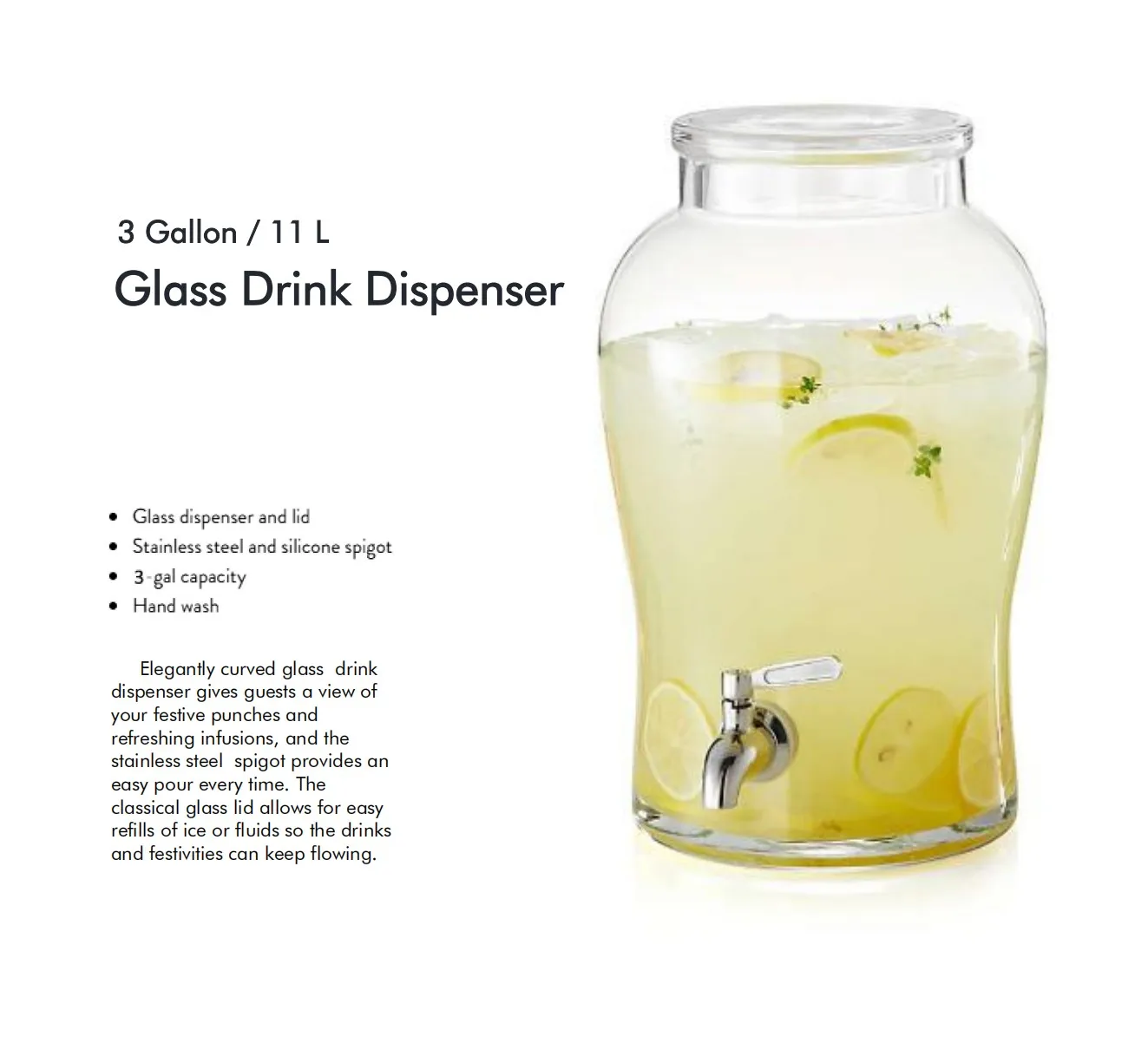
Full, this dispenser weighs about 14 kg: 11 L of drink in a 3.1 kg body. That is the figure that decides whether a server carries it from the back bar to the buffet in one trip or puts it down halfway. The body narrows in a molded waist below the shoulder, so both hands sit in the recess and the load travels close to the chest instead of at arm's length.
The waist is formed in the mold, not applied, and the body is blown against a steel mold on an IS machine, so the profile repeats piece after piece. That is what a hotel refitting 60 rooms is buying: a replacement that matches the jar already standing in the room, five years later.
13.5 cm of opening, and what it allows
The mouth measures 13.5 cm across. A standard ice scoop goes in without riding over the rim, a hand goes in to wipe the inside at the end of service, and a refill from a bulk juice bottle can be aimed instead of poured blind. On a dispenser this size, that opening is what gets used twenty times a day.
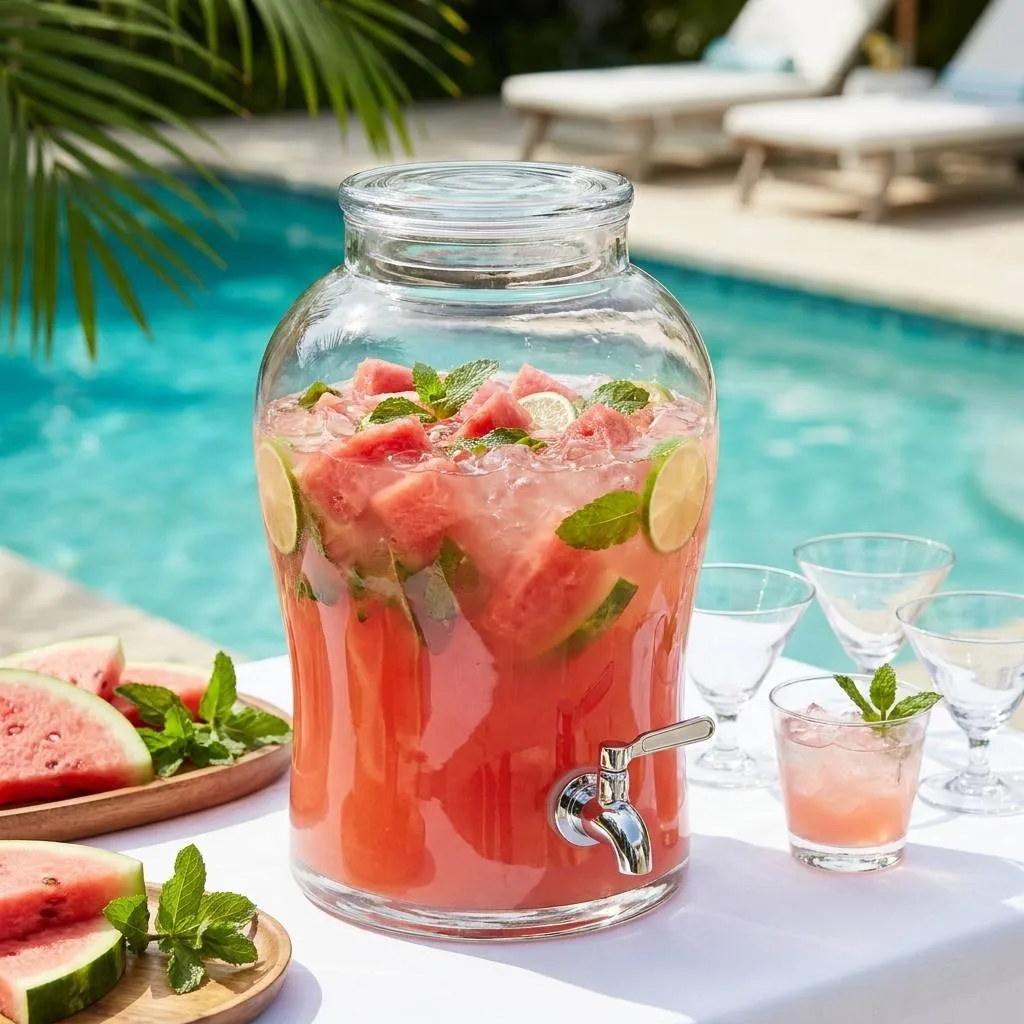
The lid is pressed glass, made as its own part and seated into the mouth rather than clamped over the rim, so it lifts off with one hand. Fitted on a buffet it slows the melt; an acacia wood lid runs on the same mouth when the program is gift-led rather than service-led, and the glass lid ships with the body as standard.
One body, four base families
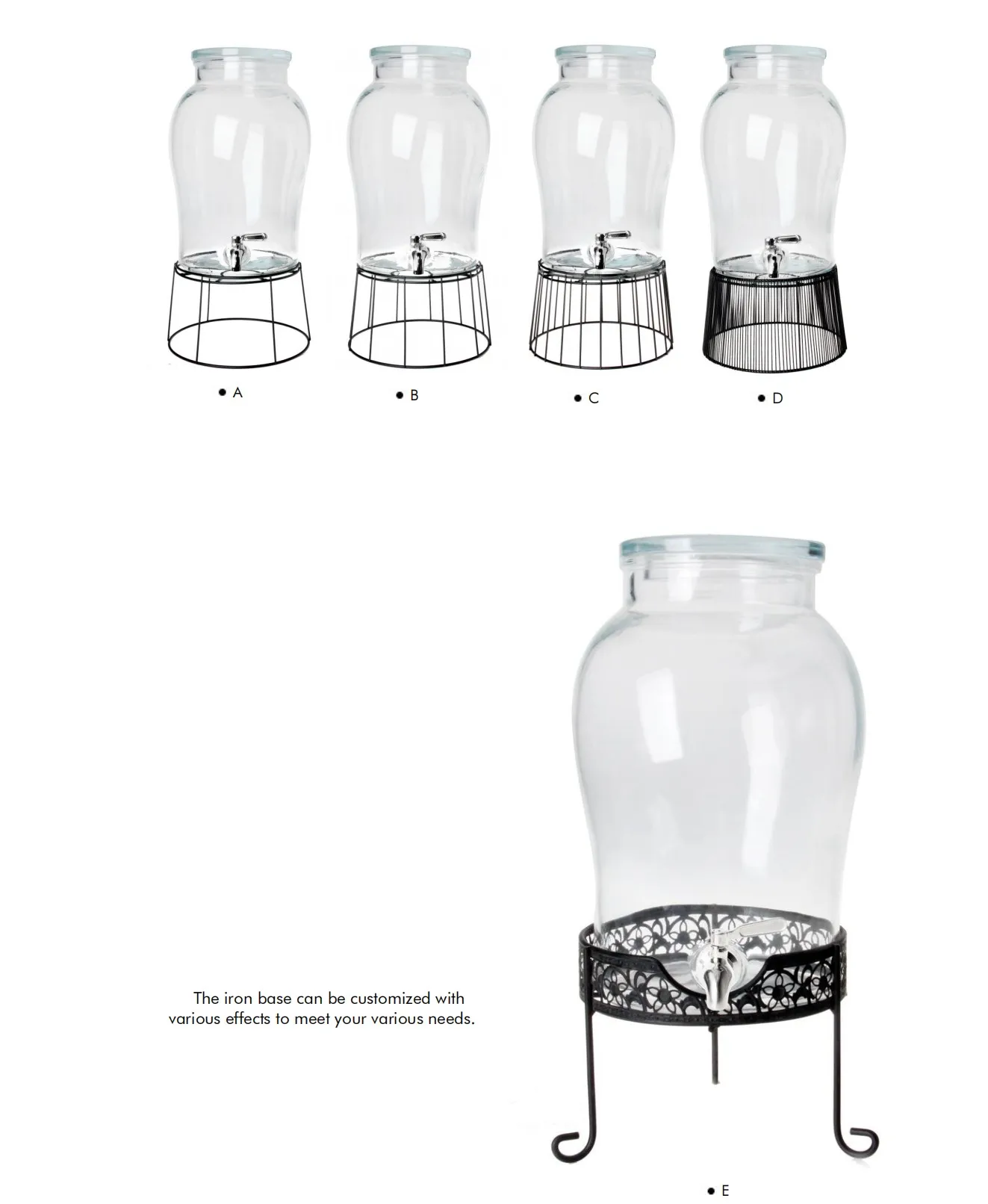
The same jar takes an acacia wood block, a marble plinth, a welded iron frame in five profiles, or a hammered metal base with a gold or silver electroplated finish. The base lifts the tap clear of the table and it is where the styling of a program happens, which is why we keep it as a separate part rather than molding a foot onto the body.
Plating is on the metal base, never on the glass. The drink stays in contact with plain soda-lime glass, and a finish change stays a component order. Each base is quoted, packed and counted on its own MOQ, so a program can run three jar colors on one base or three bases on one jar.
Four facts a buyer checks first
Where an 11 L dispenser earns its space
Eleven liters is a service size, not a tabletop size. It gets bought by operations that refill twice a day and by retail programs that sell the filled jar as a gift set, and the two want different bases on the same body.
From first message to your warehouse
How an 11 L dispenser is packed
Frequently asked questions
Q: What is the minimum order, and what does it count?
A: 1,000 pieces per style on clear glass, and the mold is already open, so there is no tooling charge on that route. It counts the glass body of one design: a second capacity is a second 1,000 and the two do not combine. Spray color adds its own minimum at 2,000 pieces per color, because each color is mixed and run as its own batch. Bases, lids and spigots are components with their own counts, quoted on the same sheet.
Q: Can we order the body on its own, without a lid or a base?
A: Yes. The body, the lid, the spigot and the base are four separate parts lines, and programs buy them in different mixes. Some customers take bodies for their own metal stands, some take the full set for retail, and some run one base across three glass colors. Tell us the mix at RFQ stage and the quote comes back split by component, so you can see what each part costs instead of a single blended price.
Q: Does the spigot drip?
A: The spigot is a threaded stainless body seated on a silicone gasket, and the seal is between the gasket and a flat seat on the glass, so what holds is the compression of that gasket rather than the thread. We do not publish a drip figure, because a tap behaves differently on water, on pulp-heavy punch and on a syrup that has been sitting in the bore overnight. Test it with your own fill at sampling: that is the only reading that means anything for your service.
Q: Is the spigot covered by a food-contact test report?
A: Not by a per-item report, and we would rather say so than leave it implied. The glass body is covered at category level, the stainless body and the silicone gasket are supplied against their material declarations, and no certificate on this page claims otherwise. If your market requires a named report for the tap and the gasket, tell us at RFQ stage and we schedule the test against your specification before production, so the document is issued on your order rather than borrowed from another one.
Q: Can it take hot drinks, or go in a dishwasher?
A: No on both counts, and it is a material answer rather than a cautious one. Soda-lime is a cold-service glass, so hot fill, a hot rinse tunnel, the freezer and the oven are outside the specification; the failure mode is thermal shock, and a shocked body is not a defect claim. Hand wash it. The base comes off first, because wood and plated metal do not go in water at all.
Q: Which lids and bases can be combined?
A: Any lid on any body, and any base under any body, because the four parts share one set of interfaces. Lids are a pressed glass lid as standard or an acacia wood lid on request. Bases are an acacia wood block, a marble plinth, a welded iron frame in five profiles, or a hammered metal base with gold or silver plating. Combinations are limited by packing and by MOQ, not by fit, so the mix you can run is a commercial question we answer on the quote.
Q: Can we put our logo on the glass and on the box?
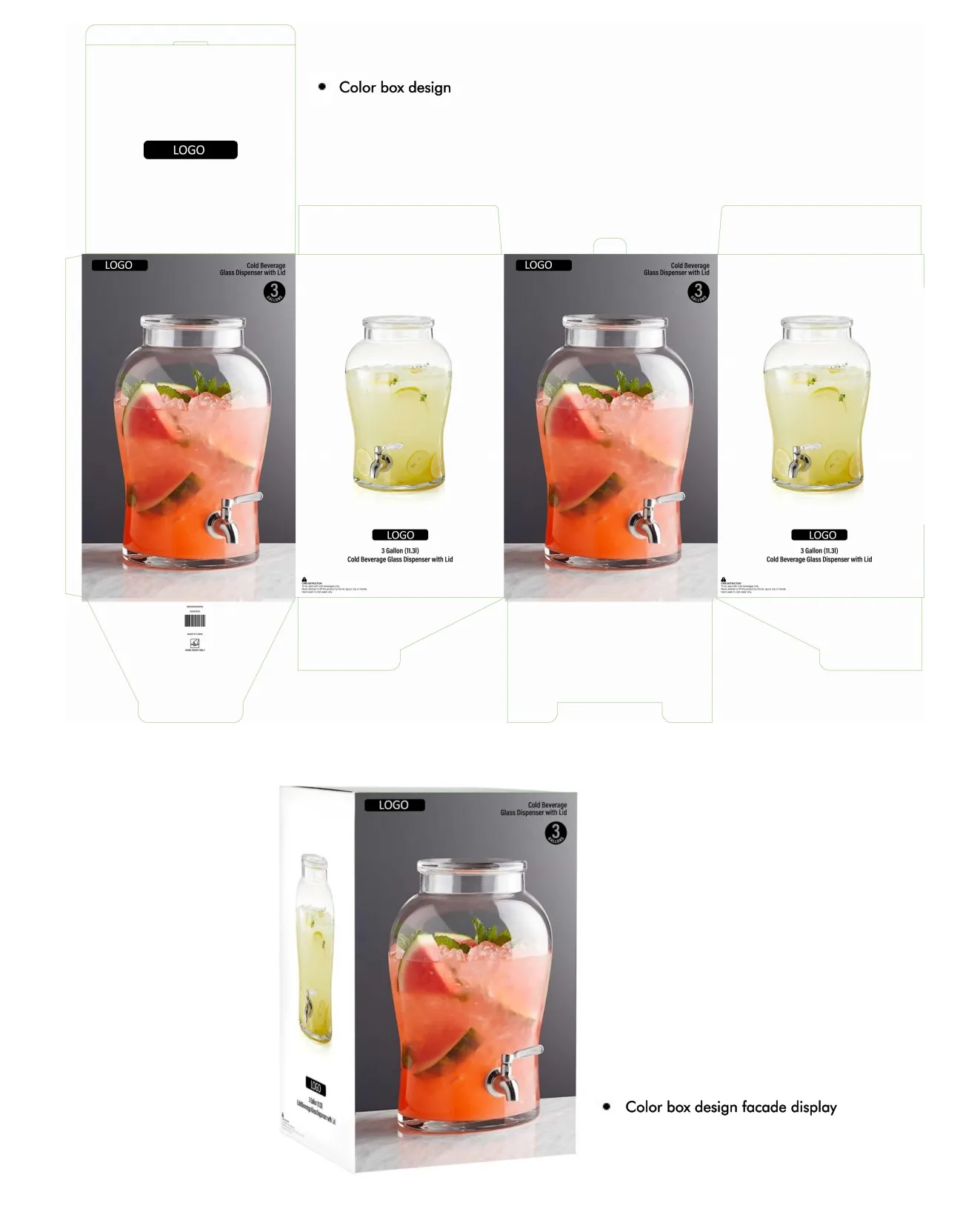
A: Yes, on both. On the glass it is silk screen, hot stamp, laser engraving or decal, and we return a layout on the actual body profile before the print is tooled, because a mark on a curved waist sits differently from a mark on a cylinder. On the box it is the printed color box with your logo and a photo panel. Artwork for both is collected at PO stage. Electroplating on the glass is not offered: plating stays on metal components, which keeps the drink in contact with plain glass.
Q: What certification covers this dispenser?
A: The glass body is lead-free soda-lime, and we hold LFGB section 30 and 31 and EU 1935/2004 test reports for this glass at category level rather than per SKU. Ask for the report scope with your quote, because a per-SKU report and a category report are not the same document and your compliance team will want to know which one it is reading. The spigot and the gasket carry material declarations only. There is no CE marking on a food-contact glass dispenser, and no FDA certificate is claimed for it.
Hot Tags: 3 gallon glass drink dispenser with lid and spigot, China, manufacturers, customized
Technical parameters
The specification below is what goes on the purchase order. Anything still open is confirmed on the order sheet before production is scheduled.
Request a Quote
Send us the target quantity, the destination port or country, and the combination you need: lid, spigot finish and base. Tell us the tallest glass your service uses as well, because the base sets the clearance under the tap. Most RFQs get a first response within 24 hours, seven days a week, and we quote FOB Qingdao as standard.
Samples of the 3 gallon glass drink dispenser are free of charge with freight collect, and physical samples are ready within 7 to 10 business days after confirmation. A 3D rendering comes back in 48 hours if you want to review the tap position and the base proportion before sampling. Production runs 30 to 60 days after deposit.
Email glassware@zgsglass.com or message us on WhatsApp +86 13105330788.
Factory: Hongcheng Financial Center, No.2 East Xinhuan Road, Zhangdian District, Zibo, Shandong, China. Factory visits are welcome, please tell us two days ahead so we can arrange a host.